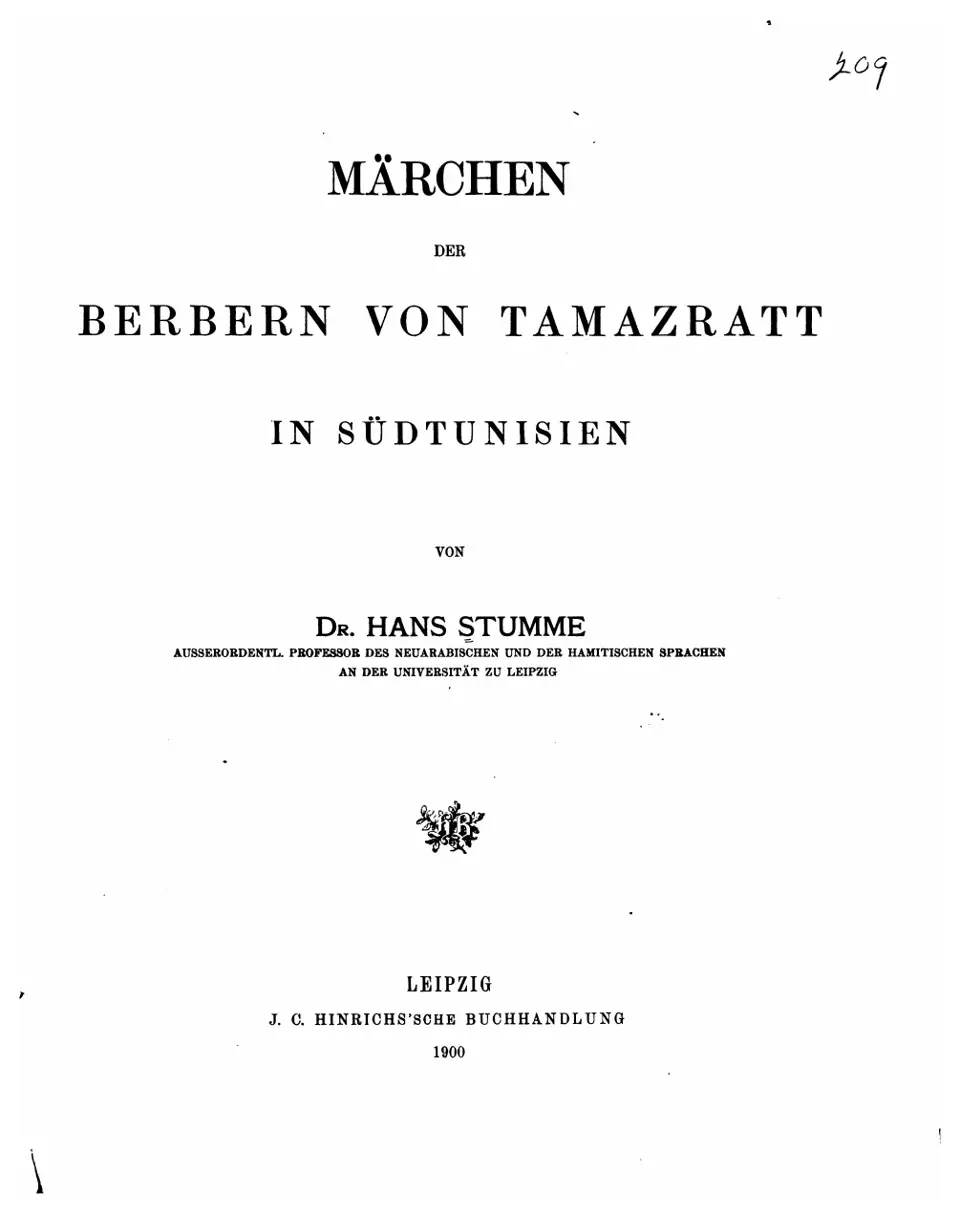
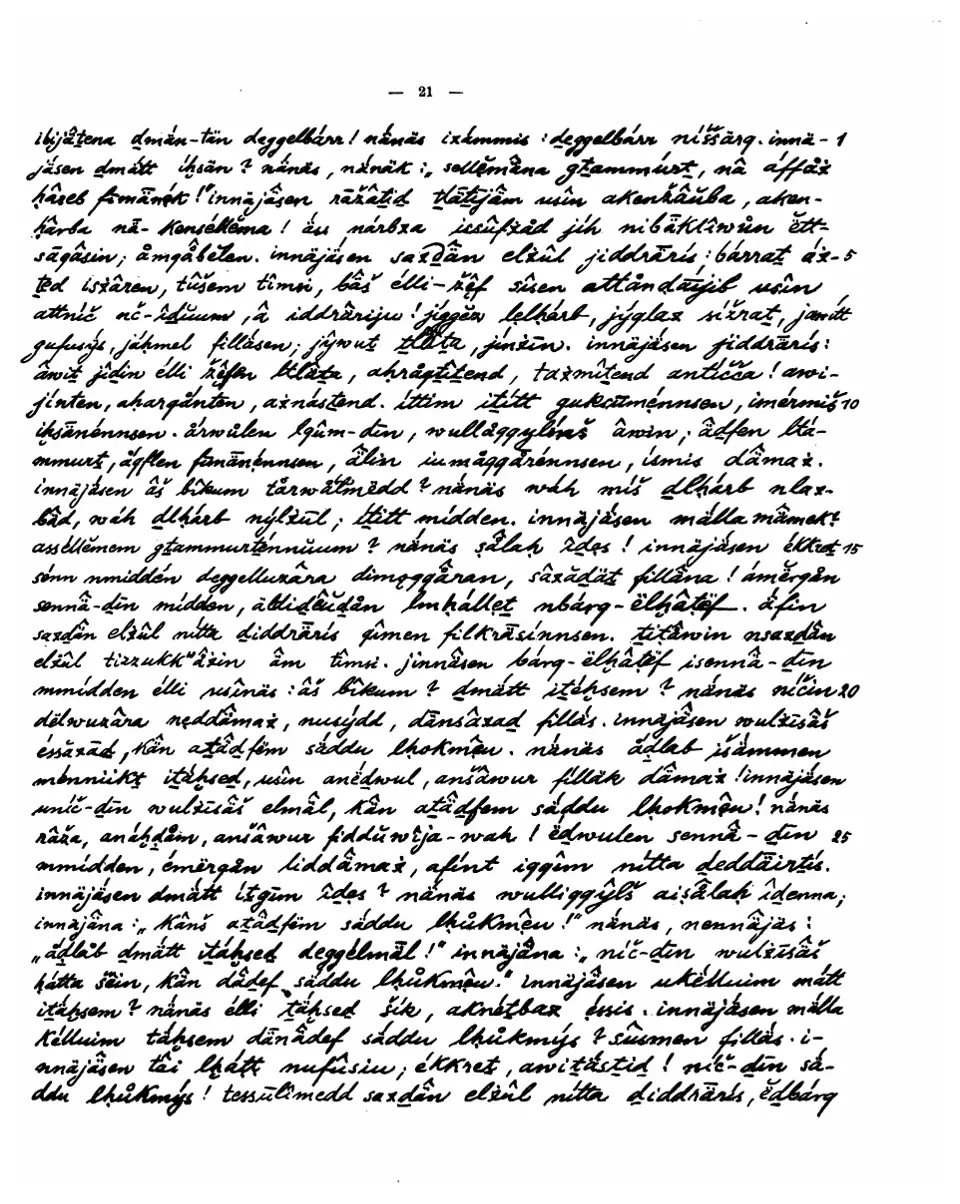
The present project is an edition of Hans Stumme’s Märchen der Berbern von Tamazratt in Südtunisien (Leipzig, 1900), a corpus of twenty-six prose narratives in the Berber variety of Tamezret, in southern Tunisia. Stumme recorded the texts in Tunis in March 1897 from two speakers of Tamezret, Mḥámmed and Mūḥámmed, aged approximately thirty and fifty; both were porters by occupation and, in addition, singers of Arabic folk song.
Although the collection is widely cited in Berber studies and its data have been drawn upon repeatedly, it has not yet served as the basis for a systematic description of the variety it documents; the language of the texts remains, to date, unanalysed. Earlier treatments of Tamezret include the unpublished theses of Paesano (2000) and Altieri (2014), both submitted at the Università degli Studi di Napoli “L’Orientale”; Ghaki (2020) has published an edition of one of the tales; and a lexicon of the variety is available (Ben Mamou 2005), though it is independent of Stumme’s material.
The difficulty lies not in the survival of the source but in its usability. Stumme’s text is a phonetic transcription and constitutes a valuable record in its own right, but it cannot be exploited directly. A prior phonological analysis is a precondition for any lexical or grammatical description of the material, and for reading, searching, and comparing the texts with confidence. Because the transcription employs a dense and idiosyncratic system of diacritics, it has never been re-edited in a form suited to such work, and access to it remains, in practice, laborious.
A methodologically comparable undertaking is van Putten’s (2014) edition of Awjila Berber, based on the texts of Umberto Paradisi. The Awjila material presents analogous problems, particularly in the domain of vocalism, where an over-differentiated phonetic notation conceals a considerably simpler phonemic system. See A Grammar of Awjila Berber.
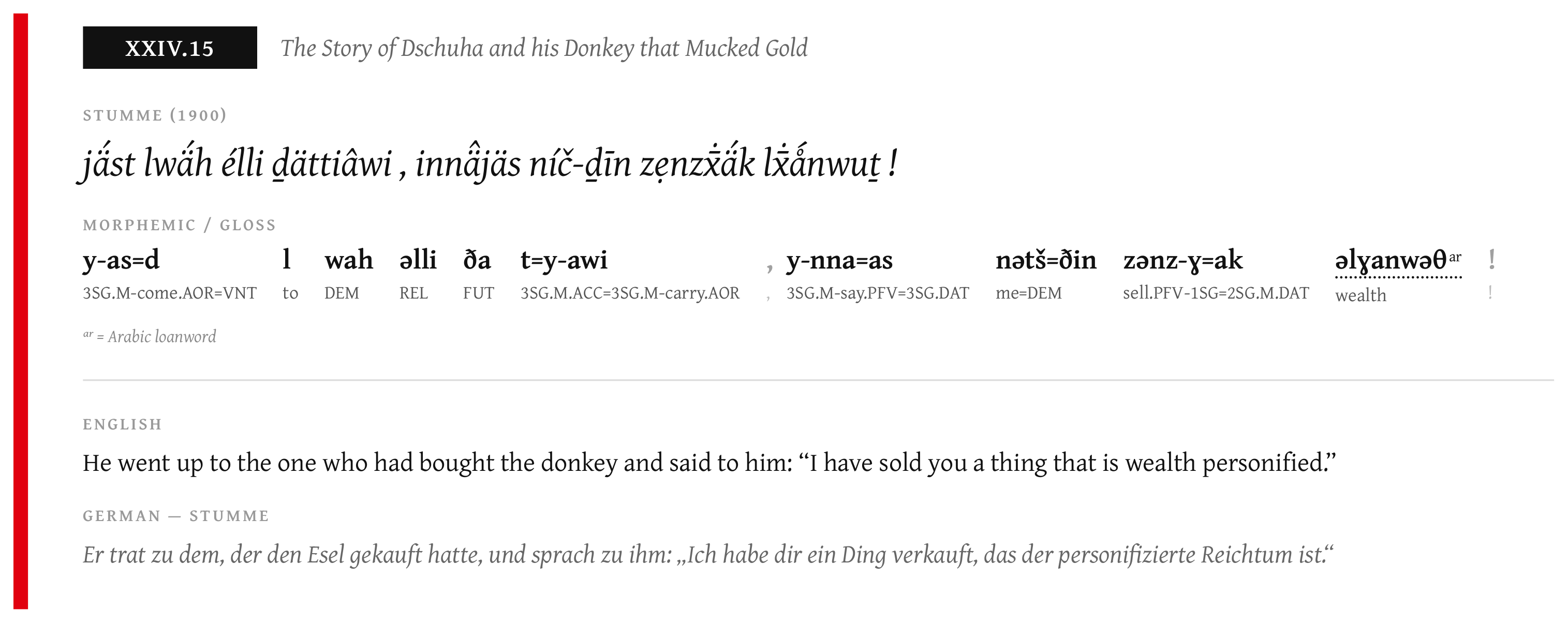
The edition digitises the original while preserving each transcription mark, and subjects it to phonological re-analysis, on the premise that Stumme’s notation is phonetic rather than phonemic. A separate layer retains the stress marking of the original, so that the material is likewise available for the study of stress. Every text is then provided with a full interlinear gloss, rendering the corpus searchable and allowing the distribution of grammatical categories to be examined across the collection. On this foundation, the edition is intended to support two further descriptive works: a grammatical description of the variety and a dictionary of its lexicon, both drawn from the corpus itself.
The texts
The twenty-six narratives may be grouped by genre as follows.
- Ogre and magic tales (I–II) — the abandoned daughters and the ogress, and Ali and the witch, in which a youngest child overcomes a cannibal antagonist through cunning.
- Fortune and merchant novellas (III–VI) — the merchant and the barber, the merchant and the prince, the two brothers, and Ahmed al-Bishri and his cousin, turning on shipwreck, commerce, and reversal of fortune.
- Court anecdotes (VII–VIII) — the Abbasid tales of Harun al-Rashid and his vizier Jafar, resolved through verbal ingenuity.
- Heroic epic (IX–XII) — Barq al-Khatef, the Banū Hilāl (Diab), ʿAntar, and al-Wuzr ben Jaber, recounting the martial exploits of warrior heroes.
- Hero-and-monster tales (XIII–XVII) — a protagonist overcomes a beast by force, or with the assistance of a grateful animal.
- Animal fables (XVIII–XXIII) — tales of the wolf, the hyena, the hare, the hedgehog, and the rooster, in the tradition of Kalīla wa-Dimna.
- Trickster and moral tales (XXIV–XXVI) — Juḥā and the gold-dropping donkey, the pious woodcutter and his avaricious wife, and the miser and his hoarded gold.
References
- Altieri, L. 2014. Il dialetto amazigh di Ath Mazret (Tamezret, Tunisia). Unpublished master’s thesis, Università degli Studi di Napoli “L’Orientale”, 2013–2014.
- Ben Mamou, El Arbi. 2005. Dialecte berbère de Tamezret (Tunisie): lexique berbère–français. 101 pp. [PDF: http://atmazret.info]
- Ghaki, M. 2017. “Un conte amazigh de Ath Mazret (Tunisie).” Paper presented at the colloquium Mouloud Mammeri (1917–1989), ou la traversée du siècle, 30 October 2017, Université Paris 1 Panthéon-Sorbonne. recorded presentation
- Ghaki, M. 2020. “Histoire du lièvre et du chacal: conte 20 en berbère de Tamazret recueilli par Stumme.” Études et Documents Berbères 44(2): 127–136. doi:10.3917/edb.044.0129
- Paesano, A. 2000. Il dialetto berbero di Tamazret (Tunisia). Unpublished thesis, Istituto Universitario Orientale, Napoli, 1999–2000.
- Stumme, H. 1900. Märchen der Berbern von Tamazratt in Südtunesien. Leipzig: J. C. Hinrichs. archive.org
- van Putten, M. 2014. A Grammar of Awjila Berber (Libya). PhD thesis, Leiden University. handle